
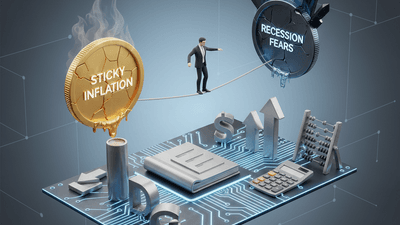



For U.S. accounting professionals, the economic landscape of early 2026 feels less like a traditional business cycle and more like a high-wire act. Business leaders are caught in a psychological tug-of-war: on one side, the lingering burn of cumulative inflation; on the other, the creeping shadow of a potential macroeconomic contraction. For CPAs, auditors, and financial advisors, this environment demands a fundamental shift. Clients are no longer asking simply "What happened last quarter?" They are urgently demanding to know, "How do we survive the next four?"
A recent analysis published by the Journal of Accountancy captures this exact tension, summing up an economic sentiment that is profoundly mixed. While headline inflation rates may have cooled from their historic peaks, the absolute price levels for labor, materials, and capital remain elevated. Simultaneously, indicators hinting at a mild recession continue to flash warning signs, leaving corporate boards and small business owners alike in a state of strategic paralysis.
The Sentiment Paradox: Inflation Fatigue Meets Growth Anxiety
To understand the practical implications for the accounting profession, we must first parse the prevailing economic sentiment. The narrative has shifted from "transitory inflation" to "sticky costs," fundamentally altering how businesses approach their 2026 budgets and beyond.
"The current economic environment is characterized by a unique duality: businesses are still fighting the margin compression caused by years of cumulative inflation, while simultaneously hoarding cash in preparation for a forecasted demand slump."
This duality places immense pressure on the accounting function. Controllers and CFOs are being tasked with finding cost-cutting measures that do not cannibalize future growth. Meanwhile, external CPAs are stepping into a vital advisory role, helping clients untangle conflicting data points to make sound financial decisions. The anxiety is palpable, but for proactive accounting firms, it presents a golden opportunity to deepen client relationships through enhanced Client Advisory Services (CAS).
The Advisory Imperative: Moving from Scorekeepers to Strategists
When economic sentiment sours, the perceived value of historical financial reporting diminishes. Clients need forward-looking intelligence. Here is how leading accounting professionals are adapting their advisory frameworks in response to inflation and recession fears:
1. Dynamic Scenario Planning
Static, annual budgets are virtually obsolete in a volatile economy. Accountants must guide clients toward rolling forecasts and dynamic scenario planning. This involves modeling multiple economic realities:
- The Base Case: Inflation remains sticky, interest rates hold steady, and consumer demand sees a slight, manageable dip.
- The Stagflation Case: Costs continue to rise while revenues flatline or contract, requiring aggressive cost-containment strategies.
- The Recession Case: A sharp drop in demand necessitates immediate liquidity preservation, workforce reduction modeling, and debt restructuring.
2. Cash Flow Defense and Margin Protection
With the cost of capital remaining a significant hurdle, cash is unequivocally king. Accounting advisors must help clients scrutinize their working capital cycles. This means aggressively managing Days Sales Outstanding (DSO), optimizing inventory levels to prevent holding costs from eating into margins, and locking in favorable pricing with vendors where possible.
| Macro Risk Factor | Primary Client Impact | Recommended CPA Advisory Action |
|---|---|---|
| Sticky Inflation | Margin compression, rising OPEX, wage spirals | Conduct pricing power analyses; implement rolling 13-week cash flow forecasts. |
| Recession Threat | Revenue contraction, delayed receivables | Stress-test debt covenants; advise on discretionary spending freezes. |
| High Interest Rates | Increased cost of capital, frozen M&A activity | Evaluate lease vs. buy options; explore alternative financing or R&D tax credits for liquidity. |
Audit and Compliance: Heightened Professional Skepticism
The implications of this economic uncertainty extend far beyond advisory services; they strike at the core of the audit profession. When companies face financial strain, the risk of material misstatement—whether due to error or fraud—inevitably rises. Auditors operating in the U.S. market must exercise heightened professional skepticism, particularly in areas involving significant management judgment.
Going Concern Evaluations (ASC 205-40)
Recessionary fears combined with high borrowing costs mean that "going concern" assessments will be a major focal point for 2026 audit engagements. Auditors must rigorously evaluate management's plans to mitigate financial distress. If a client relies on refinancing debt that matures in the next 12 months, auditors must critically assess the feasibility of that refinancing in the current rate environment.
Asset Impairment (ASC 350 and ASC 360)
As economic sentiment fluctuates, so do future cash flow projections. This has a direct impact on the valuation of long-lived assets and goodwill. Auditors must challenge the assumptions baked into management's impairment models. Are the revenue growth rates realistic given the looming threat of a recession? Are the discount rates appropriately reflecting the current inflationary risk premiums?
Internal Firm Dynamics: Managing the Squeeze
It is crucial to remember that accounting firms are themselves businesses navigating this exact same economic tightrope. Firm leaders are dealing with their own version of the inflation-recession paradox.
- Pricing Pushback: As clients tighten their belts in anticipation of a recession, they are increasingly pushing back on audit and tax fee increases.
- Talent Costs: Despite the broader economic cooling, the accounting profession is still grappling with a severe talent shortage. To retain top-tier CPAs, firms are forced to maintain high compensation levels, squeezing partner margins.
- Technology Investments: To offset labor shortages and improve efficiency, firms must invest heavily in AI and automation—a capital expenditure that is difficult to swallow when borrowing costs are high.
To survive, U.S. accounting firms must practice what they preach to their clients. This means aggressively pruning unprofitable client relationships, standardizing service delivery to protect margins, and shifting billing models from hourly rates to value-based pricing, particularly for high-demand advisory services.
Conclusion: The CPA as the Ultimate Economic Anchor
The data from the Journal of Accountancy paints a picture of an economy holding its breath. Whether the U.S. tips into a formal recession or simply endures a prolonged period of stagnant growth and sticky prices, the margin for error for businesses has vanished.
In times of boom, accounting is often viewed as a compliance exercise. In times of uncertainty, it becomes the lifeblood of corporate survival. U.S. accounting professionals who can translate macroeconomic anxiety into actionable, microeconomic strategies will not only shepherd their clients through this high-wire act—they will cement their status as indispensable strategic partners for decades to come.